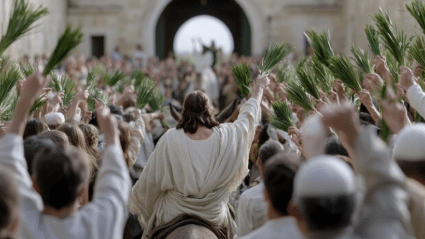
The Triumphant Entry is like a big parade, with people holding palm branches and shouting, “Hosanna”. Beneath the surface, it’s like a blueprint for how we, as believers, can experience victory in our own lives. It’s not just about Jesus riding into Jerusalem; it’s about what that means for us today. The scripture says, ‘Blessed is the King who comes in the name of the Lord!’ Peace in heaven and glory in the highest!” Luke 19:38
To understand what it means to be ‘the triumphant’ in a modern world, we must look past the crowd and into the specific, divine mechanics of that day. The significance of our victory is not found in the volume of our praise but in our consecrated surrender.
In this sacred intersection of humility and power, we find that the Christian life is not a struggle for triumph but a journey of walking in the victory already secured by the King who rides into the “Jerusalems” of our hearts.
This entry was not merely a parade; it was a prophetic declaration that the methods of the world—might, force, and ego—had been superseded by the methods of the Spirit. When we look at our own lives, we often find ourselves exhausted by the effort of trying to “win” our battles. (Zechariah 9:9)
We treat faith like a muscle we must flex until the situation changes. However, the revelation of the Triumphant Entry suggests that victory is less about our exertion and more about our occupancy. It is about who is sitting on the throne of our current circumstances. To be triumphant is to host the presence of God in the midst of the mundane, the messy, and the miraculous alike.
THE SURRENDER OF THE SELF!

When Jesus approached Jerusalem, He did not choose a warhorse, the traditional symbol of earthly conquest and military power used by Roman generals to strike fear into the hearts of the conquered. Instead, He requested a young donkey—a colt on which no man had ever sat. (Matthew 21:2)
This choice is the first profound revelation of triumphant living: God’s glory manifests through the unblemished and the yielded. In the economy of the Kingdom, “triumphant” does not mean being the strongest in the room; it means being the most occupied by the King. The colt was insignificant by worldly standards, yet it became the vehicle for the Ancient of Days because the Lord “had need of it”.
There is a deep mystery in the fact that this animal was “unbroken”. Naturally, such a creature is wild, resistant to direction, and prone to panic, especially in a noisy, shouting crowd with people throwing garments and branches under its feet. Yet, under the weight of the Prince of Peace, that wild nature was instantly stilled.
This reveals the core of our spiritual triumph: the subduing of the “flesh”—the wild, unbroken nature within us—by the weight of His glory. To live triumphantly is to allow the Lordship of Christ to settle upon our natural inclinations until our wild impulses are harmonised with His divine direction. The colt did not struggle because it was occupied by the Creator of Peace.
When you are truly occupied by Christ, the “noises” of life—the critics, the financial storms, and the spiritual opposition—cannot cause you to stumble. You move with a supernatural composure because you are carrying the weight of the world’s true kings.
This surrender is further mirrored in the “Road of Garments”. As Jesus rode, the crowd spread their cloaks on the road. In biblical culture, a garment represented one’s identity, status, and protection. It was often a person’s most valuable possession, identifying their rank in society. By laying them down, the people were metaphorically laying down their lives for His path.
True triumph is found in this total divestment. We cannot carry the King and our own reputations at the same time. The “triumphant” are those who have decided that their personal “cloaks”—their egos, their past achievements, and their self-preservation—are better used as a carpet for His progress than as a covering for their own pride. Motivation in the Christian walk springs from this: knowing that as we lower ourselves, the King is elevated, and where the King is elevated, victory is inevitable.
To live as one of the Triumphant is to recognise that our “loosing”—the moment we are freed from the ties of the world, just as the colt was loosed from its tether—is for the express purpose of service. We are loosed, to be bound to Him. The world sees freedom as the absence of a master, but the triumphant see freedom as having the right master.
When the world asks, “Why are you doing this?” our response is the same as the disciples’: “The Lord has need of it.” This is the ultimate motivation: knowing that your life, your talents, and even your “unbroken” parts are useful to the King of Glory. Your potential is not found in your pedigree but in your proximity to the Saviour.
THE MYSTERY OF THE PALM BRANCHES

To fully grasp the title of “The Triumphant”, we must also look deeply into the second major element of the entry: the waving and spreading of palm branches. In the ancient Near East, the palm was not merely a convenient piece of greenery; it was a sophisticated symbol of victory, righteousness, and resilience. By exploring its layers, we find a revelation for our own spiritual strength that transcends physical circumstances and anchors us in eternal truth.
The biology of the palm tree itself provides a startling spiritual revelation: unlike most trees, the more weight you place upon a palm, the straighter and stronger it grows. In the ancient world, it was known as the tree that “refuses to be pressed down”. It does not have a central bark that can be stripped to kill it; its life is on the inside, protected and resilient. This is the hallmark of the Triumphant Christian.
We are not defined by the absence of pressure but by our response to it. Just as the crowd waved these branches to signal a victory over oppression, we are reminded that our trials are not meant to break us. Instead, they act as the very resistance that forces our spiritual stature to grow tall and reach toward the heavens. To live triumphantly is to possess the “palm tree spirit”—a resilience that translates every burden into a ladder for higher growth.
Furthermore, the word ‘Hosanna’ (meaning ‘Save now, I pray’) was a cry of urgent expectation. Living triumphantly requires a shift in our temporal perspective. We do not serve a God of “eventually”; we serve the God of “Now”. The Triumphant Christian operates in the immediate sufficiency of God.
Victory is not a destination we reach at the end of our lives; it is the atmosphere we carry today. Because Christ has already entered the gates, we are not fighting for victory, but from victory. The palm branch is a reminder that we are celebrating a King who has already conquered the greatest enemies: sin, death, and the grave.
This revelation reaches its ultimate climax in the eternal realm. In the Book of Revelation (7:9), a “great multitude… from every nation” stands before the Throne, clothed in white and holding palm branches in their hands. This connects our current challenges to our future certainty.
The palm branches in Jerusalem were eventually trampled and dried, but the palms in the hands of the redeemed in heaven are eternal. This teaches us that the “Triumphant” perspective is an everlasting one. When you face a battle today, you aren’t just fighting as a person on earth; you are aligning yourself with the version of “you” that is already standing before the throne, victorious and palm-bearing.
Your current victory is simply an earthly echo of your heavenly reality. True Christian triumph, therefore, is the ability to maintain our “Hosanna” even when the path leads through a “Gethsemane”. It is the strength to keep waving the palm of praise even when the world demands our silence.
We must understand that the crowd in Jerusalem was fickle—many who shouted “Hosanna” on Sunday would shout “Crucify him” on Friday. But the triumphant are not moved by the changing winds of popular opinion or the fleeting emotions of the moment. Our triumph is anchored in the character of the One we carry. The revelation of the Triumphant Entry challenges us to move beyond a “spectator” faith.
It is easy to stand on the sidelines and wave a branch as the king passes by. It is much more challenging, and much more rewarding, to be the vessel that carries Him. When we offer our lives as the “colt”, we find a peace that surpasses understanding. When we offer our praise as the “palm”, we find a strength that overcomes the world. This is the secret of the triumphant: we are victorious not because of what we have done but because of who we have welcomed into our lives.
Remember, the journey of the triumphant does not end at the gates of Jerusalem; it begins there, in a life marked by surrender. Lay down your garments of self-reliance, pick up your palm of praise, and walk the path that leads straight into the unending glory of the triumphant king. If you will do this, I decree and declare a life full of joy and an unbeatable, triumphant life in Jesus’ name.
May the Lord bless you and keep you; may the Lord make His face shine upon you and be gracious to you. May the Lord lift His countenance upon you and give you peace.