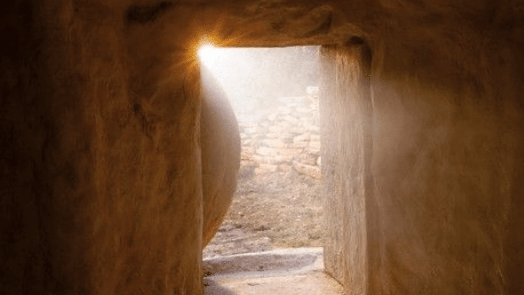
When we think of Easter, our minds usually drift toward the cinematic: the blinding light, the earthquake, the terrified Roman guards, and the heavy stone rolling away like a coin on its edge. But the real “mind-blowing” revelation is hidden in the quiet, structural geometry of the tomb itself. The scripture says, “God raised him from death to life and destroyed the pains of death, because death had no power to hold him” (Acts 2:24 GWT).
To understand it, we have to look through the eyes of Mary Magdalene as she peered into that cold limestone cave. She saw something that most readers of the Gospel of John gloss over, but it contains the entire blueprint of our redemption. She saw two angels in white, sitting exactly where the body of Jesus had been, one at the head and one at the feet (John 20:11-12).
If you are a student of the Old Testament, your heart should skip a beat at that description. This isn’t just random heavenly seating. This is a precise, physical replica of the Ark of the Covenant. In the ancient Tabernacle, the most sacred object was the Ark. On top of that gold-covered box was the Mercy Seat (the Kapporet). It was flanked by two golden cherubim, one at each end, their wings overshadowing the centre (Exodus 25:17-22)
Once a year, on the Day of Atonement, the High Priest would enter the pitch-black Holy of Holies and sprinkle the blood of a sacrifice on that seat to cover the sins of the nation. It was the “hot zone” of God’s presence—the place where a holy God met a broken humanity. It was restricted, dangerous, and hidden behind a thick veil. (Leviticus 16:14–15)
In that moment on Easter morning, the tomb was transformed from a place of “unclean” death into the New Holy of Holies. The stone slab where Jesus lay became the ultimate mercy seat. But there was one massive, universe-shifting difference: the seat was empty.
By rising, Jesus “de-sanctified” the religious monopoly on God. He proved that the presence of the Father was no longer trapped in a gold box or a hidden temple room. By turning a grave into a throne, He signalled that there is no “dead zone” in your life that is too far gone for His glory (Hebrews 9:11–12).
This is the human reality of the empty tomb: your greatest trauma, your deepest regret, and the “graves” of your failed dreams are exactly where He wants to set up His Mercy Seat. He doesn’t just visit your mess; He rebrands it as His sanctuary. He took the “unclean” reality of a mortuary and made it the most sacred space in existence.
But the architecture of hope doesn’t stop with the angels. We have to talk about the “linen clothes”. John’s Gospel notes with peculiar detail that the face cloth (the sudarium) wasn’t just tossed aside; it was “folded up in a place by itself”. (John 20:6–7)
In the ancient Near Eastern world, a master at a meal used his napkin to communicate with his servant. If the master rose and crumpled his napkin, it was a signal that he was finished and wouldn’t be returning. However, if he folded his napkin neatly, it was a silent code to the servant: “I am not finished; I am coming back.”
By folding that cloth, Jesus left a “sticky note” for all of humanity. He was telling us that the Resurrection wasn’t a one-time magic trick or a quick exit from a bad situation. It was the start of a persistent, multi-generational project of restoration. He was saying, “I am still at the table of human history. I am still working, still redeeming, and I am coming back for the rest of the family.”
The empty tomb is the proof that God never leaves a job half-finished. If He started a work of grace in you, the folded napkin is His promise that He hasn’t walked away from the table of your life. This “Holy Architecture” also reveals a shift in the legal standing of the human soul.
In the Old Covenant, the blood was sprinkled on the seat to cover sin. In the New Covenant, the tomb is empty because the debt has been fully cleared. If Jesus were still in the grave, it would mean the “check” of His sacrifice had bounced. But the empty tomb is the divine receipt. It is God the Father’s “Amen” to Christ’s “It is finished”.
You don’t have to live in the “courtroom” of your own conscience anymore, trying to prove your worth. The judge has released the prisoner, and in doing so, he has released you. The empty tomb isn’t just a historical “fact” to be tucked away in a creed; it is a new way of being human.
Leaving grave cloths behind

We often live our daily lives as if we were still wearing “grave clothes”—the old habits, the lingering shame of our past, and the labels our parents or our exes or our failures put on us. We walk through life with the scent of the cemetery on our skin. But look at the tomb: Jesus left the linens behind. Why? Because you cannot walk in New Creation power while you are still dressed for a funeral.
When you know the tomb is empty, you realise that God isn’t looking to scrap your life and start over with a “Plan B”. He is in the business of resurrecting “Plan A”. Notice that the tomb was located in a garden. This is a massive theological “Easter egg”. Humanity lost its identity in a garden (Eden). Jesus wrestled with the weight of our sin in a garden (Gethsemane). And He rose in a garden. (John 19:41)
The Empty Tomb is the “Womb” of the New Creation. It tells us that God is restoring the “original you”—the one before the world broke your heart, before the trauma stole your joy, and before the sin clouded your vision. He doesn’t just want to give you a “new life” in the sense of a different one; He wants to give you a resurrected life—one that has been through the fire and come out indestructible. A resurrected body still had scars, but those scars no longer hurt; they were trophies of a battle won.
We also have to grapple with the “borrowed” nature of the tomb. Joseph of Arimathea was a wealthy man who gave his private burial plot to Jesus. But Jesus only needed it for a long weekend. This is a profound metaphor for every trial you are currently facing. Every “night of the soul”, every season of silence where it feels like God has abandoned you, and every situation that feels like a dead end are only temporary rentals. You aren’t staying there.
We often treat our problems like permanent residences. We decorate our despair and move into our disappointment. But the empty tomb shouts at us to “keep moving”. It reminds us that we are just passing through the valley of the shadow of death—we aren’t building a house there. The stone hasn’t just been rolled away from Jesus’ grave; it has been rolled away from your future.
To live as an “empty tomb person” means to operate with a level of “resurrection boldness”. The early disciples went from hiding in locked rooms to standing before emperors, not because they had a new philosophy, but because they had seen a man who was dead walking around eating fish.
That kind of reality ruins you for a “normal”, fearful life. It gives you the courage to forgive the person who betrayed you because you know your life isn’t in their hands—it’s in the hands of the One who holds the keys to death and Hades.
It gives you the strength to be generous when you are broke because you serve a God who can bring something out of nothing. It gives you the peace to face a terminal diagnosis or a crushing loss because you know that for the believer, the grave is just a “changing room” for eternity.
The empty tomb is the final “Amen” to the story of God’s love. It is the womb where hope was reborn. It proves that light is stickier than darkness, and life is more stubborn than death. So, walk out of your “tomb” today. Leave the linen clothes of your past shame behind. Don’t look for the living among the dead.
The Master has folded the napkin, the angels are standing guard over your transformation, and the garden is in full bloom. The empty tomb brings the fullness of God’s favour, victory, joy, abundance and all spiritual blessings in Christ. I decree and declare that your life will receive the fullness of every benefit connected to the death and resurrection of Jesus Christ in Jesus’ name.
May the Lord bless you and keep you; may the Lord make His face shine upon you and be gracious to you. May the Lord lift His countenance upon you and give you peace.